
'The Chinese thought India would back off. 'They did not expect such a firm Indian response to their expansionist manoeuvre.'

'Our villagers used to go up to Finger 4 and Finger 6, but today the Chinese are there.' 'Since April 2020, Chinese troops have blocked Indian troops from reaching at least ten patrolling points running from the Depsang plains in the north to Pangong Tso lake in the south.'
The MEA said it was the Chinese side that recently undertakook activities hindering India's normal patrols in the areas.

'I want to assure this House that in these talks we have not conceded anything.' Full text of what Defence Minister Rajnath Singh told Parliament on the Chinese pullback in eastern Ladakh.
'The Chinese have been moving in step by step; inch by inch for the last 40 years.'

Under the India-China agreement on the disengagement process in eastern Ladakh, the Chinese army will pull back its troops to east of Finger 8 areas in the northern bank of Pangong lake, Defence Minister Rajnath Singh said in Parliament on Thursday, in what is seen as a significant step to dial down tensions in the key face-off site.

"All temporary structures and other allied infrastructure created in the area by both sides have been dismantled and mutually verified. The landform in the area has been restored by both sides to the pre-standoff period," the Army said in a statement.
India and Pakistan have agreed to strictly observe all agreements on ceasefire along the Line of Control (LoC) and other sectors, according to a joint statement on Thursday.
The Ministry of External Affairs said the two ministers discussed the outstanding issues related to disengagement from all friction points along the Line of Actual Control in eastern Ladakh.
'India cannot allow Beijing's policy of stabilising and destabilising the border at will to perpetuate its own ends.' A riveting excerpt from Manish Tiwari's 10 Flashpoints; 20 Years National Security Situations That Impacted India.

"The message is clear. We're not going to stand by and let China or anyone else take the reins in terms of being the most powerful, dominant force, whether it's in that region or over here," White House Chief of Staff Mark Meadows told Fox News.
'We hope this round of meeting, on the basis of previous meetings, can move forward, further enlarge consensus, narrow differences and work for a solution that is acceptable to both parties,' the spokesperson said in updated comments posted on the ministry's website.

The government must figure out what the Chinese game plan is and thwart the endgame before it is upon us, possibly in early winter, advises David Devadas.

'The numbers of troops on both sides are enormous.' 'They are about 50,000-60,000 soldiers facing each other in that sector -- that's about the total number of troops that both sides had in the 1962 War in all sectors.'
'We will not accept these misadventures by the Chinese.'
Experts have said the economic cost of China's misadventure in the last couple of months in eastern Ladakh and South China will be "massive" as it has "exposed" Beijing's "real face" when the entire world is fighting coronavirus.

Narrowing of differences on competing territorial claims along the un-demarcated LAC might take weeks, if not months, of hard-nosed negotiations. Without some give and take on both sides, the impasse will be hard to resolve, observes Virendra Kapoor.

'China is unwilling to restore the status quo ante of April 2020.' 'India will have to weigh its options based on this premise.'

'The Chinese can't be trusted hence the need to verify and re-verify.'
There was no comment from the Indian side on the statement made by the Chinese defence ministry spokesperson Colonel Wu Qian, and carried by China's official media.
'India is not the India of 1962. We are not carrying that baggage of history anymore.'
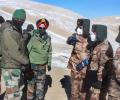
"The meeting thus did not result in resolution of the remaining areas," the Army said in a statement.

China has started the construction of at least 13 entirely new military positions including three air bases, five permanent air defence positions and five heliports near the Line of Actual Control (LAC) in the aftermath of the Doklam standoff in 2017, according to a report by global security consultancy Stratfor.
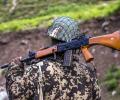
Talking about dealing with the border issue faced by India, Jaishankar, without naming any country or going into details, said, "You know again we did what we had to do. There was a very active debate which still continues to this day. It is natural for people to offer advice, often on matters which they may not have particular knowledge of, that are a human trait. But again if there was what came through it was that we were resolute, we were strong about protecting our interests."
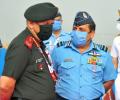
Gen Rawat's comments about the supporting role of the Air Force came at a conference when asked about the growing perception that the Indian Air Force was not keen on setting up the proposed theatre commands integrating the capabilities of the three forces.
The sources said both sides held extensive deliberations on modalities for disengagement of troops from all the friction points in eastern Ladakh at the talks.

The Indian and Chinese armies have been locked in a bitter standoff at multiple locations in eastern Ladakh for over eight weeks since May 5.

Gen Naravane said that the Indian Army did not hide casualties during Galwan clash in eastern Ladakh as the Chinse have done.
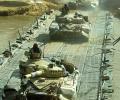
DRDO plans to build a tank for use in the mountains and in the jungles.

'The PLA has continued to do exercises and drills and recently carried out air exercises with fighter jets.'
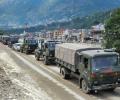
Indian Army planners find themselves contemplating the possibility of more Chinese intrusions along the contested 3,488-km border. That could lead to the army having to man a 'hardened LAC' round the year, like the LoC with Pakistan, reports Ajai Shukla.

'Why wouldn't so strategically-minded an adversary, such as China, not militarily exploit to the maximum Indian timidity, stupidity, and cupidity all along the LAC and legitimate, as it has done so often in the past, the fait accompli of incremental territorial grabs which, by the way, is its strategy and policy as implemented on the ground?'
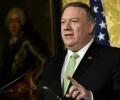
"I've spoken with Foreign (External Affairs) Minister (S) Jaishankar a number of times about this (Chinese aggressive actions). The Chinese took incredibly aggressive actions. The Indians have done their best to respond to that," Pompeo told reporters at a news conference in Washington, DC.

Indian Army chief General Manoj Mukund Naravane on Tuesday said that as far as the western front was concerned, there is an increase in the concentration of terrorists in various launch pads and there have been repeated attempts of infiltration across the Line of Control.

'Once positions are hardened and troops start building defences, it is difficult for soldiers to step back.'

China has chosen to keep New Delhi guessing, while retaining for itself the option of constantly changing facts on the ground and shifting the LAC westwards -- the strategy called 'salami slicing', notes Ajai Shukla.

General Zhao Zongqi is well known in India for having commanded the Chinese troops during the Dokalam episode. Zhao knows every inch and corner of the Indian border, at least the Eastern and Central sectors, including the Naku La area which witnessed fist-fights between Indian and Chinese troops in April/May. Claude Arpi introduces us to the PLA generals masterminding the Chinese aggression in Ladakh.

India must break out of this strategic triangulation between China and Pakistan. We need to settle our issues with one of the two, notes Shekhar Gupta.

'He is psychologically preparing the PLA and the Chinese public to avoid a loss of face.'

'Even if there is no full-scale war, Galwan-like skirmishes cannot be ruled out.'
 © 2026 Rediff.com - Advertise with us - Disclaimer - Privacy Policy - Sitemap - Feedback - About us - Terms of use - Grievances